
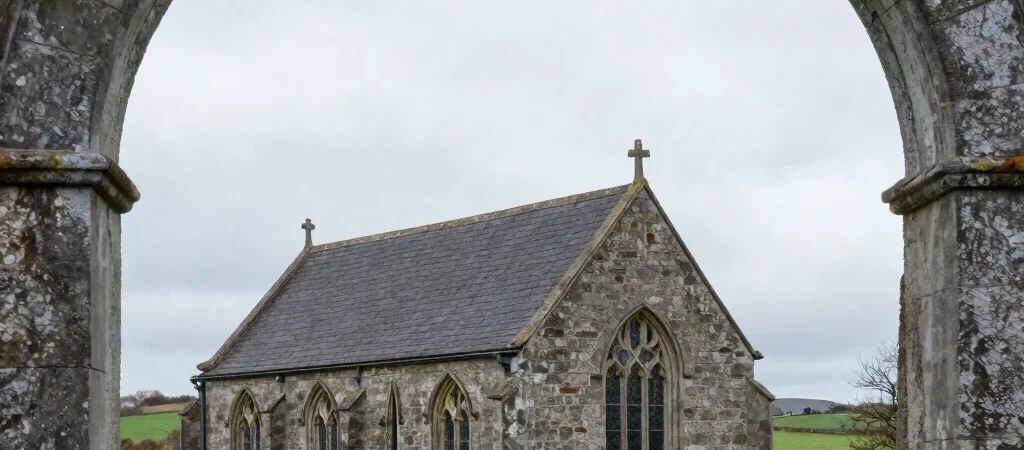
A broken arch can draw the eye, but it cannot tell the whole story of a church. Across Ireland, pre-Reformation religious sites survive in different states, from substantial remains to fragments within a later landscape. The useful question is not only what the stone looks like, but what evidence can still be read around it.
Look beyond the doorway
Building fabric can offer clues about construction and change, while grave markers and surrounding boundaries point to the site’s relationship with a local community. A church may have been altered, reused, or left incomplete over time. Its present condition is one moment in a longer history, not a snapshot of its original life.
Put the place in context
The wider setting matters too. A site’s proximity to a settlement, a route, or other religious remains can prompt questions about how people reached it and how it connected with neighboring communities. Local records and archaeological work may clarify those questions, but a landscape view alone should not be mistaken for proof.
Resist the easy story
Ruins invite neat explanations: a single dramatic ending, or an unchanging picture of medieval faith. The evidence is often less simple. Religious life varied across places and periods, and surviving stone cannot stand in for every Irish Christian community before the Reformation.
When visiting or studying a church ruin, look closely, ask what evidence supports each interpretation, and leave room for what remains unknown. That approach respects both the history held in the stones and the people whose lives are only partly visible.